GDR’s Top 10 Shanghai retail openings

From a ship-shaped Louis Vuitton exhibition to Arc’teryx’s museum concept store, Shanghai is home to some of the most architecturally inspiring and culturally ambitious flagship stores we’ve ever seen.
There’s a tangible shift underway as brands look to move on from transactional retail spaces to instead create real cultural destinations that attract visitors and encourage them to spend time in physical branded spaces. These are stores as stages for storytelling, hospitality and community, with products almost incidental to the experience.
Louis Vuitton — “The Louis”, HKRI Taikoo Hui, Wujiang Road, Jing’an

The most architecturally audacious retail opening of 2025 in China and perhaps globally. Designed by Shohei Shigematsu of OMA, ‘The Louis’ is a 30-metre-high, ship-shaped structure moored on Wujiang Road, clad in the brand’s monogram motif with a metallic silver hull, a bold red stripe, and upper levels that mimic stacked Louis Vuitton trunks. The concept pays homage to LV’s 19th-century heritage of crafting travel trunks while honouring Shanghai’s identity as the “Gateway to the East.” Inside, a 1,600 sq m space delivers the Visionary Journeys exhibition (free with WeChat registration), Le Café Louis Vuitton on the third floor with a fusion East-meets-West menu by chefs Leonardo Zambrino and Zoe Zhou, and a retail floor with Shanghai-exclusive hot-stamping personalisation services. Entry is free – the space functions as much as a cultural destination as much as a store.
Mi Shang Prada Rong Zhai, 186 North Shaanxi Road, Jing’an
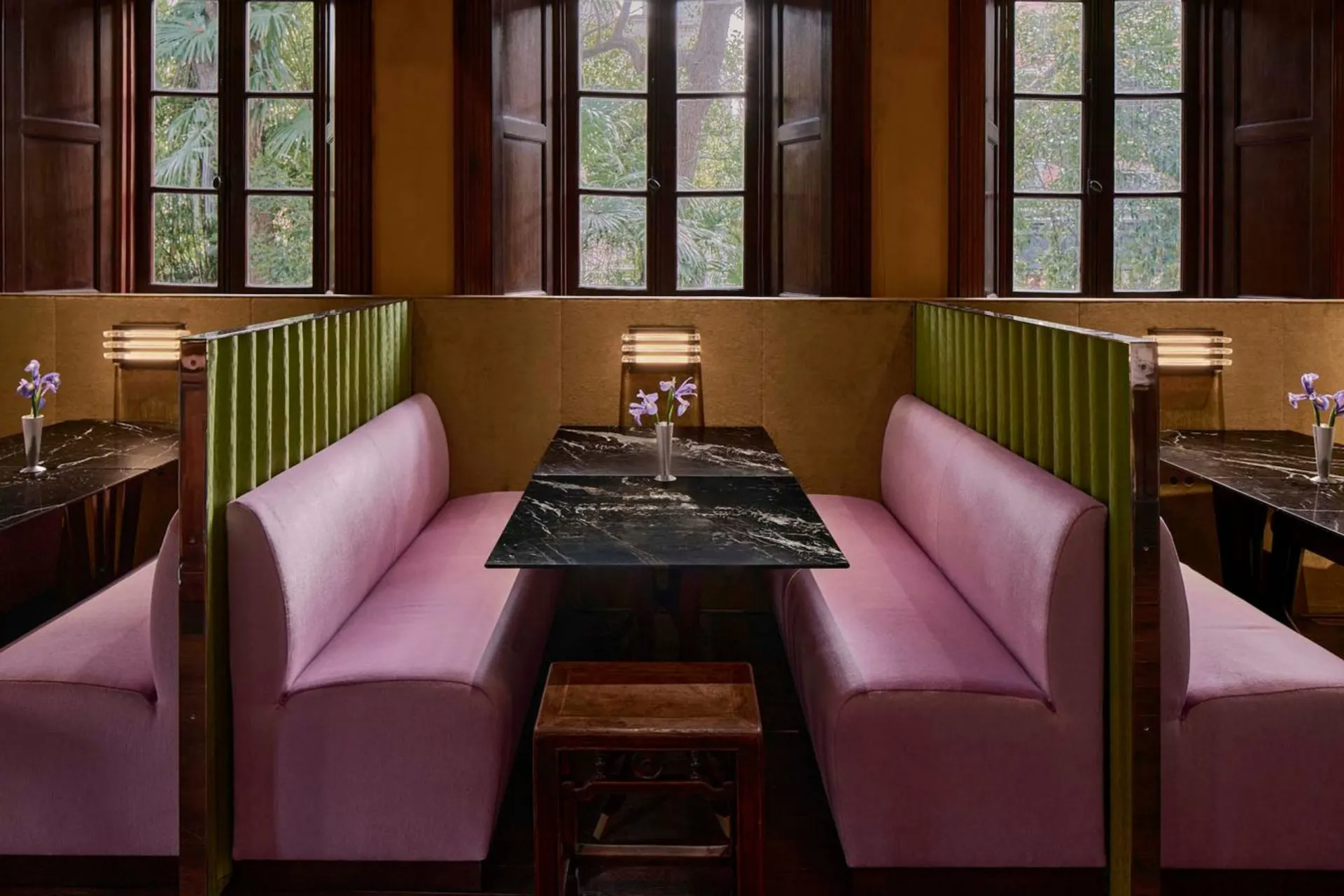
Prada’s first standalone fine dining space in Asia in March 2025 on the second floor of Rong Zhai, the 1918 historic villa the brand acquired in 2011 and has operated as a cultural hub since 2017. The restaurant and café, named Mi Shang (“to be obsessed with”), was conceived by Hong Kong-based director Wong Kar-wai. His signature aesthetic shows in every room, with mirrored surfaces, soft saturated colour and a dreamlike atmosphere. A sequence of spaces unfolds like a cinematic walkthrough: The Pastry Shop (cherry wood, brass, Italian bakery references), The Café (velvet furnishings, locally crafted bar counter), The Dining Room (pink, green and yellow interiors; neon echoes; pink velvet booths against black marble tables), The Study (curated books, terrace) and The Apartment (VIP retail experience by appointment). Woodblock prints created by Wong in collaboration with historic auction house Duo Yun Xuan are permanently displayed. The building continues to host two annual art exhibitions.
Casa Loewe Shanghai, Jing’an Kerry Centre, 1515 West Nanjing Road

Casa Loewe Shanghai opened in February 2025 as the brand’s largest store in Asia, almost 700 sq m across two floors in Jing’an Kerry Centre. The facade is the main talking point: 35,536 individual golden ceramic tiles, handcrafted by Barcelona-based Studio Ceràmica Cumella using materials from the mountains of eastern Spain. The tiles shift and shimmer with changing light, referencing both Loewe’s Spanish origins and gold’s connotation of luck in Chinese culture. The neighbouring Jing’an Temple’s gold detailing echoes the choice. Inside, Jonathan Anderson’s Casa concept transforms the space into a collector’s home, with Gerrit Thomas Rietveld Utrecht armchairs, Axel Vervoordt floating stone tables, John Ward ceramics, Hafu Matsumoto bamboo weaving, Ernst Gamperl’s oak vessel, and paintings by Ken Price and Mahesh Baliga. The building’s opening generated over 75 million Weibo views.
Longchamp, La Maison de Famille, 12 Wukang Road, French Concession, Xuhui

Longchamp’s “La Maison de Famille” opened in October 2025 at the corner of Wukang and Anfu Roads in Shanghai’s French Concession. It’s a listed modernist building designed by architect Harry Tam in 1948, the same year the brand was founded. It’s Longchamp’s first standalone experience space globally. The two-storey, 150-200 sq m villa is organised more like a family home than a boutique: each room — living room, dining room, kitchen, library, playroom, dressing room — reflects a different member of the Cassegrain family and is decorated to illustrate their personalities. A Café Longchamp serves traditional French dishes in Gien faience ceramics from a Loire Valley atelier founded 200 years ago. Since its soft opening, it has become one of Longchamp’s top-performing stores in Shanghai despite carrying no advertising whatsoever.
Hoka Global Brand Experience Centre, Xintiandi, Madang Road, Huangpu

Hoka’s inaugural global brand experience centre opened in May 2025 in the pedestrianised Xintiandi area. At 1,600 sq m across three floors on Madang Road, it is the largest Hoka store in the world by some distance. It features the Hoka Lab: China’s first full-body physical fitness testing facility open to the public, equipped with six international-grade devices covering gait analysis, strength, mobility and biomechanics, and is the first Hoka location anywhere to offer performance testing to consumers – something that was previously reserved for professional athletes. The Xintiandi location is a strategic choice, as the district has become the benchmark for premium sports and outdoor brand flagships in China, with Salomon, On and Kolon all opening there in 2024.
Arc’teryx Museum, 1717 West Nanjing Road, Jing’an

Arc’teryx opened what it calls its ‘Museum’ on West Nanjing Road in January 2025. This immersive 2,400 sq m flagship is set across four floors and four thematic sections inspired by Vancouver’s Coast Mountains, with rocky cliff environments, forests, glacial zones and urban terrain. Visitors ‘hike’ through the store as they make their way around, with landscaped design elements reflecting each zone. The first in-store exhibition showcased the seven generations of the iconic Alpha SV jacket since 1998. A second UCCA Lab-curated exhibition explored the evolutionary origins of the Arc’teryx Archaeopteryx logo, a fossil considered by many to be the first species of bird. The store includes an Arc’teryx Academy, a ReBIRD repair and care service, offering hemming, GORE-TEX laundering, restoration, and regular community events including clinics, run clubs and talks.
Adererror Shanghai Space, Sir Robert Ho Tung Residence, 457 North Shaanxi Road, Jing’an
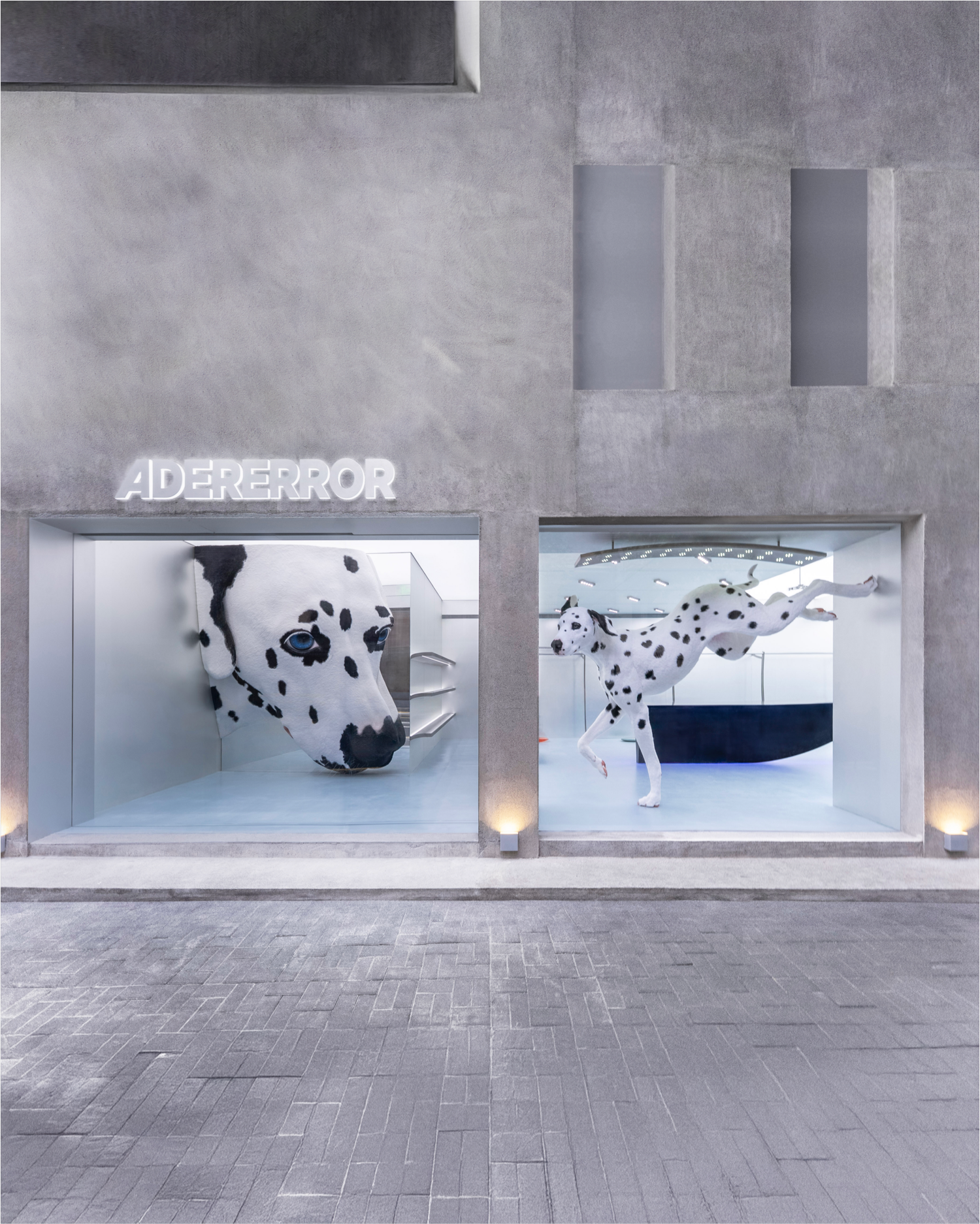
Seoul-based cult fashion label Adererror opened its first China flagship in October 2025 inside the historic Sir Robert Ho Tung Residence – the 1928 Jing’an villa designed by architect László Hudec, which recently underwent a full restoration and reopened as a cultural space in 2024. Adererror has always positioned its stores as art spaces as much as fashion destinations and this one is no exception. The two-storey flagship collaborated with five artists to create site-specific podiums and objects in their signature materials, while a giant Dalmatian installation at the entrance has become a social media magnet and one of the most photographed new retail moments in the city. Four fitting rooms each offer a distinct atmosphere and design. The black, white and grey palette, metallic textures and industrial lighting create an atmosphere the brand describes as “futuristic yet artistic.”
Pop Mart, Shimao, East Nanjing Road, Huangpu

Pop Mart opened its new flagship on East Nanjing Road’s Shimao development in November 2025 — 800 sq m across two floors, designed as an immersive space for pop-culture collectibles. The opening anchored the pedestrian strip’s transformation into a hub for collectibles in the city. The store features the first-ever Autobot combiner from the 2025 Transformers Age of the Primes range, over 100 pieces of Transformers merchandise, a Transformers × Hot Wheels exclusive box set and 10 brand-new products launched on opening day. Pop Mart’s trajectory in 2025 marks one of the year’s most remarkable brand stories: the company’s annual revenue passed RMB 13 billion for the first time, up 107% year-on-year, as the “kidult” collectible culture it created went fully global.
Huawei, Taikoo Li Qiantan, Pudong
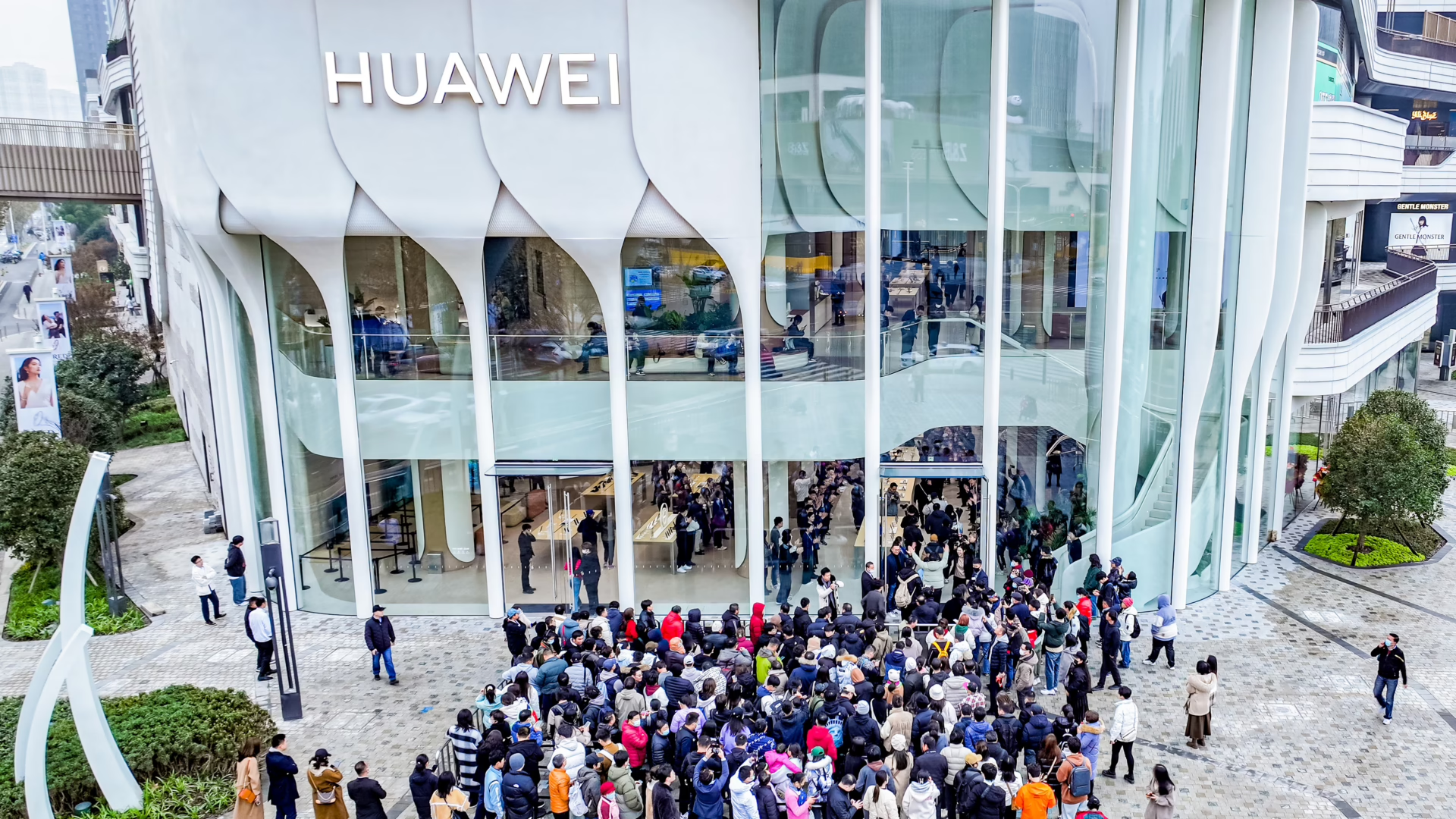
Huawei’s Taikoo Li Qiantan flagship was designed by Amsterdam practice UNstudio and stands as one of the most architecturally accomplished consumer tech stores in the country. The petal-like facade evolves in scale and rotation as visitors approach — symbolising the integration of nature and technology — with frameless glass maximising natural light and embedded lighting elements creating a soft glow at night. Inside, the centrepiece is the Tree of Harmony: a spiralling feature element visible from both inside and outside, using AR to provide immersive sensory experiences of nature that connect to Huawei’s technology offer. A warm palette of ivory, wood and GRC runs throughout; experiential zones are interwoven with product display tables in a fluid, non-zoned layout. High-performance recycled materials are used throughout, alongside a circular sustainability brief.
Boucheron, Xintiandi, Huangpu

Boucheron’s first mainland China flagship opened in Xintiandi in November 2025 — the Maison’s third global landmark, alongside Place Vendôme, Paris, and Ginza, Tokyo. Housed in a restored 19th-century shikumen townhouse, the 278 sq m space treats the building’s hybrid Chinese-Western origins as the design brief itself. Two gardens frame the entrance, with a French winter garden on one side and a Moon Gate and water feature evoking the classical Chinese garden on the other. Inside, a staircase of metallic prisms shifts from Boucheron’s signature emerald green to auspicious Chinese red as guests ascend. Artist Xiaojin Yang’s “Lingzhi Forest” installation anchors the ground floor; a painted celestial dome by Claire Nicolet crowns the space above. VIP salons on the upper floor are dressed in De Gournay wallpaper drawn from the Song dynasty masterpiece A Thousand Li of Rivers and Mountains.